

Halt Cancer at X
Turning community support into better odds against breast cancer – locally and nationally..
Every July, thousands of spectators pour into Kalispell, Montana’s Flathead Valley for The Event at Rebecca Farm —five days of world class equestrian competition and all-in-the-family style hospitality. While horses are the stars all five days, The Event’s hoofprint extends far beyond the Valley, affecting lives in ways that have nothing to do with horses.
Since 2012, The Event has been home to the Halt Cancer at X (HCX) charitable initiative. The name is a reference to the point where competitors halt in the center of the arena to salute judges. HCX’s mission is to support today’s breast cancer patients and research aimed at reducing the number of those patients in the future. Its muse is Rebecca “Becky” Chaney Broussard, the founder of The Event who was lost to breast cancer in 2010.
What began as a way to honor a beloved mother now has remarkable local and potentially worldwide impacts: over $1.1 million raised, grants to dozens of organizations, and now, an investment in research with the potential to change how breast cancer is diagnosed forever.
Halt Cancer at X’s History
Halt Cancer at X was founded by Sarah Broussard in 2012, two years after she took over The Event’s reins following the death of her mother, Becky Broussard. Becky had built The Event at Rebecca Farm from the ground up — alongside her husband Jerome — starting in 2002. She dreamed of creating a world-class equestrian venue in Kalispell where riders could compete at the highest levels, and where the public could witness the power and grace of the Olympic equestrian sport of Three-Day Eventing.
Sarah carried that dream forward. And she added one of her own.
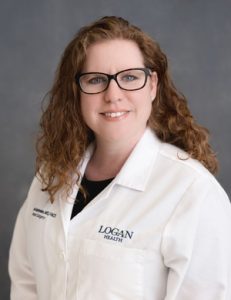
“Honoring her mother by helping others facing breast cancer requires the type of bravery and belief that is uncommon in the general population, but that you do find in the eventing community,” says Dr. Melissa Kaptanian, board chairwoman of Halt Cancer at X and a surgical oncologist at the Logan Health Breast Center in Kalispell. “Asking your horse to leap over obstacles when they cannot see the other side, and having that animal trust you entirely — that is the kind of leadership and faith that led Sarah to found Halt Cancer at X.”
In its first year, HCX drew overwhelming support from the equestrian community and from local Flathead Valley residents and businesses. It was that community outpouring that shaped HCX’s dual mission: funding national breast cancer research and supporting local organizations serving those affected by the disease.
To date, HCX has distributed over $500,000 in community grants to local nonprofits, and $650,000 to national breast cancer research initiatives — including two previous grant recipients who later secured National Institutes of Health “R01” grants, the gold standard of research funding. In total, over $1.1 million has been raised and distributed.
HCX has quietly built a track record of funding researchers at critical times.
“HCX grants have traditionally tried to pick researchers who are early in their scientific careers — before they have the track record needed to attract major federal funding,” Dr. Kaptanian explains. “We’re one of the organizations getting people started. And we’ve had two previous grant recipients go on to get NIH R01 grants. That, to us, is additionally wonderful.”
A Quest to Eliminate Diagnostic Limbo
 Earlier this year, the Halt Cancer at X committee awarded its 2025 National Research Grant to Drs. Miglena Komforti and Ruifeng Guo, pathologists at Mayo Clinic Florida in Jacksonville. Their work sits at the intersection of molecular biology and breast cancer diagnostics. If it succeeds, it could eliminate one of the most agonizing experiences a patient can face.
Dr. Kaptanian describes the problem in plain terms: “So most people get a biopsy with a needle. The biopsy says, ‘Thank goodness, it’s not cancer’ — or, ‘Darn it, it is.’ But there’s also a squishy middle ground, where the pathologist says, ‘Gee, some of these cells look atypical, but we’re not sure.’ And then there’s more waiting, and more testing, and sometimes I have to take that person to the operating room to have a surgery — just to tell them whether or not it’s cancer.”
That uncertain middle ground affects roughly 10% of all needle biopsies — a number that translates to tens of thousands of patients each year left in limbo awaiting an answer. Additional procedures, anxiety, and sometimes surgeries they may not have needed, characterize this experience.
Drs. Komforti and Guo are developing a test called QCIGISH — Quantitative Chromogenic Imprinted Gene In-Situ Hybridization — that works by detecting a specific molecular change that occurs in cancer cells at a very early stage. Cancer disrupts a normal process called genomic imprinting, in which certain genes are “silenced” in healthy cells. QCIGISH identifies this disruption directly on pathology slides, in real time, at the individual cell level.
“This is the first epigenetic test of its kind offering real-time diagnostics of breast cancer and cancer precursor lesions at the single cell level,” explains Dr. Komforti. “It streamlines clinical integration with AI-driven image analysis, with a turn-around-time of 24 hours and results directly visualized on pathology slides. Successful retrospective validation on Mayo Clinic data indicates QCIGISH is precise, quantitative, reproducible, and cost-effective.”
The goal is eliminating diagnostic uncertainty: “No more indeterminate breast pathology results,” Dr. Komforti continues. “No more unnecessary excisions. Upon successful completion of this research, QCIGISH will provide patients with a personalized breast cancer risk model — changing breast medicine and breast cancer care forever.”
Immediate Impact
Dr. Kaptanian and the HCX committee were moved by both the science and its immediacy. “The committee heard a couple of excellent proposals, and we really liked this one because it was so immediate. We could all put ourselves in the shoes of someone who could be helped if we helped move this research forward,” she says. “This technology could save thousands of women every year from getting a needle biopsy result of ‘we don’t know — you need surgery to find out if you have cancer or not.’ This is an issue I see in my practice every week.”
The surgical oncologist is also clear-eyed about the nature of scientific research: “Benchtop research is benchtop research. This could be a dead end. But that’s why it requires real vision to say, ‘We’re going to invest in the science.’ If it yields the result we want, fantastic. But even if it doesn’t pan out, everybody still learns, and the knowledge base of the world is still better. That’s the faith that goes with basic science.”
Closer to Home: The 2025 Community Grant Recipients
Alongside the national research grant, HCX continues its commitment to the women of northwest Montana through community grants to local nonprofits. In the fall of 2025, four organizations received funding — each addressing various needs and realities involved in beating breast cancer.
Casting for Recovery offers 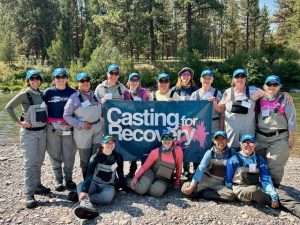 free fly-fishing retreats to local breast cancer survivors. Through therapeutic activity, peer connection, and time on the river, these retreats give women a chance to reclaim their sense of strength and possibility in their bodies. “They go out to the river and camp, commiserate and celebrate,” Sarah Broussard says. “I think everybody needs that kind of community, and we’re very proud to support it.”
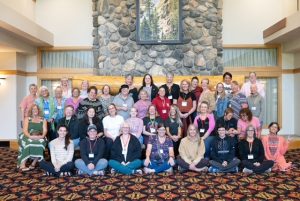
Cancer Support Community Montana ensures that peopleaffected by cancer are empowered, strengthened, and sustained — including through their annual Mending in the Mountains women’s retreat, which the HCX grant helps make possible.
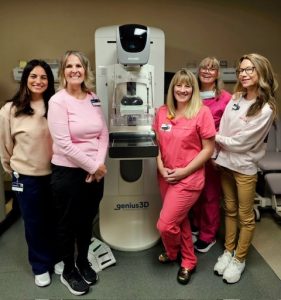 Tough Enough to Wear Pink of Montana hosts an annual free mammogram day at multiple locations across the state. On October 9, 2025, their event provided free breast screenings to 22 women in Kalispell alone — in a single day. Early detection saves lives, and access to screening in rural Montana is not a given.
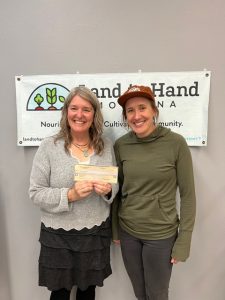 Land to Hand‘s Food Rx program provides bi-monthly fruit and vegetable prescriptions to patients experiencing food and nutrition insecurity. With this HCX grant, they will support 10 women affected by breast cancer — because surviving cancer is not only about treatment. It’s about nourishment, dignity, and the ability to heal completely.
“Our community grants represent what we know to be true,” says Dr. Kaptanian. “It’s not just about surviving breast cancer. It’s about living your best life afterwards. That’s what we’re focused on.”
Proactive Practices
Breast cancer is a tough foe. Invasive forms of the disease will affect approximately one in eight women, and it accounts for roughly 32% of newly diagnosed cancer cases in women every year. Cases have been rising about 1% a year, between 2012 and 2021, with the steepest rise in women under 50 years of age.
There are no vaccines or sure-fire ways to avoid breast cancer, but there are ways to lower the risks, Dr. Kaptanian stresses. She calls screening mammograms “our best weapon” and laments the fact that many patients fell out of the habit of getting them regularly during and after COVID. Active lifestyles and maintaining a healthy weight are some of the best protections against the disease.
And, like The Event at Rebecca Farm, we can all donate to causes like HCX that support research and those affected by the disease.
This July 15–19, The Event at Rebecca Farm returns for its 25th year. Whether you’re a lifelong equestrian or a newbie to the sport, there’s a place for you at Rebecca Farm. Enjoy the Shopping Fair with retail and food vendors, and the Kid Zone with its free pony rides. Spectator admission and parking are free. The grounds are spectacular. And every HCX auction bid and donation goes directly toward research and support that changes lives.
For more information or to donate to Halt Cancer at X, visit www.rebeccafarm.org.
